01
A Collaborative Caregiving & Safety net App
Project Brief
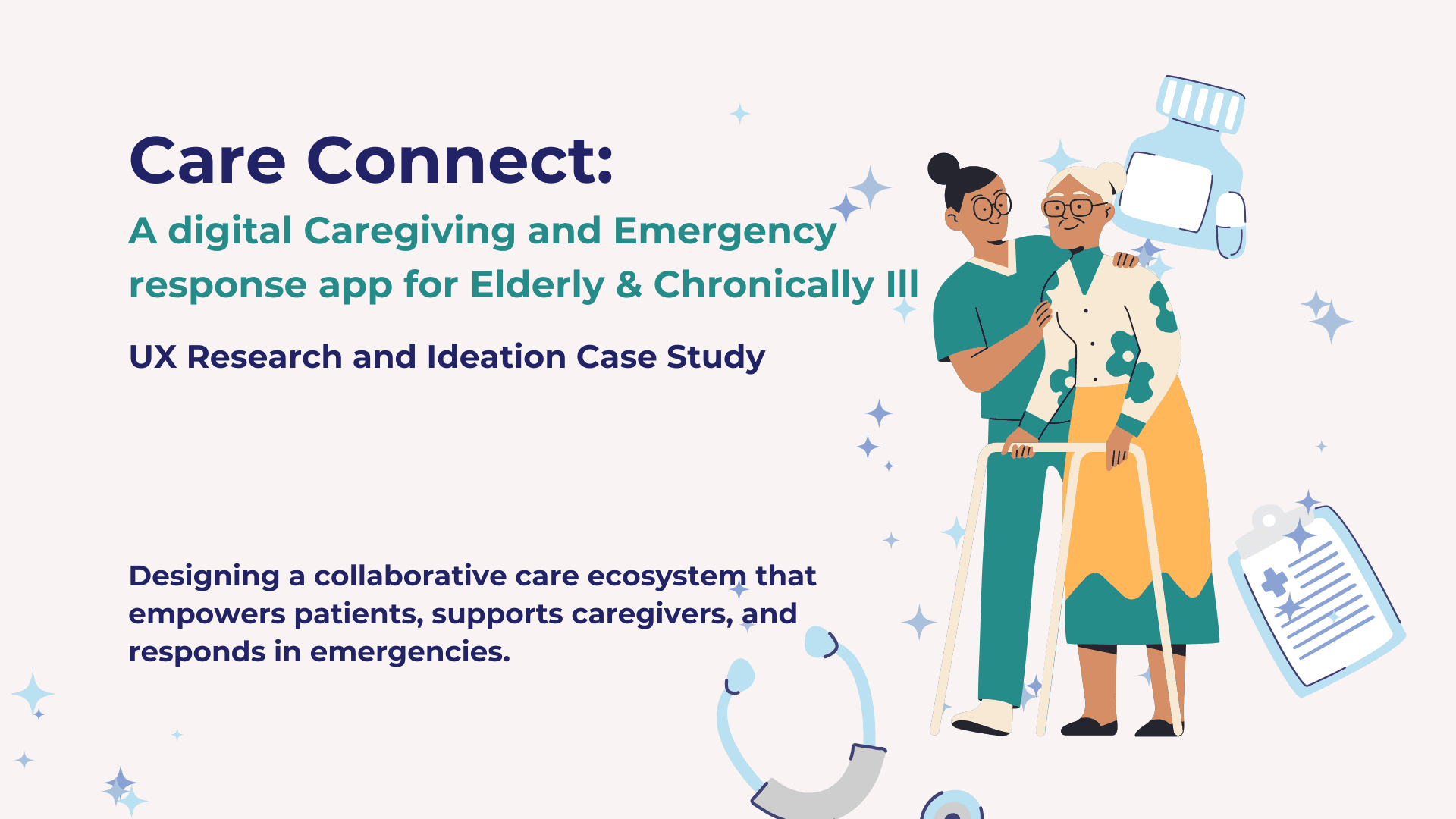
Care Connect is a mobile platform designed for elderly and chronically ill individuals, functioning as a digital caregiver as well as a bridge between Patient, caregivers, emergency responders and doctors.
Problem
Elderly and chronically ill individuals often require continuous health monitoring, medication management, emotional support, and emergency preparedness. However, many live alone or have caregivers who are not consistently available. Informal caregivers if present, lack structured tools to support their loved ones or patients without constant manual coordination. Existing healthcare apps are either too clinical, too complicated, or don’t support collaborative use between patients, caregivers, and doctors. This creates stress, reduces compliance with care routines, and puts patients at greater health risk.
Solution
Care connect acts as a digital caregiver that supports users in their day-to-day needs like health tracking, reminders, wellness, emotional check-ins, appointment bookings and emergency readiness. It allows collaborative caregiving by letting trusted family or friends manage tasks like setting reminders or booking appointments when needed etc. Emergency contacts and responders are looped in intelligently without causing chaos. The app is designed to give the patient a feeling of safety, reduce the fear of mishaps and the stress of caregiving.
02
Process
Research
This research phase explores the current challenges, gaps in the healthcare ecosystem, and unmet needs of both patients and caregivers. It is based on informal interviews, competitive analysis and secondary research.
Why This App is Needed
By 2030, 1 in 6 people globally will be over the age of 60, with the elderly population expected to double by 2050 (WHO). Meanwhile, over 1 in 3 adults worldwide live with multiple chronic conditions, requiring ongoing care and medication adherence.
Despite this, there remains a striking lack of centralized, user-friendly digital solutions that support both daily health routines and emergency situations. Patients and caregivers are left to juggle fragmented apps, handwritten notes, memory, and inconsistent follow-ups, leading to missed medications, delayed interventions, and avoidable hospitalizations.
there is a need for a singular, clinically-oriented interface designed to simplify, support, and safeguard everyday care.
Current Situation
Elderly and chronically ill individuals often navigate a healthcare landscape that is not designed with their daily needs in mind. While hospitals and clinics may offer professional treatment, the day-to-day management of health is left to the individual or their caregiver, often without adequate tools or guidance.
Most people rely on a mix of:
Phone calls for appointments
Handwritten notes or verbal reminders for medications
WhatsApp messages or Google Calendar for doctor follow-ups
Separate apps for emergency contacts, fitness, or health records—none of which talk to each other
This fragmentation is particularly dangerous when:
A caregiver is unavailable
A senior person forgets to take essential medication
There’s a medical emergency and no records are accessible
Early symptoms go unnoticed due to lack of monitoring
Patients miss follow-ups, which leads to deterioration in health
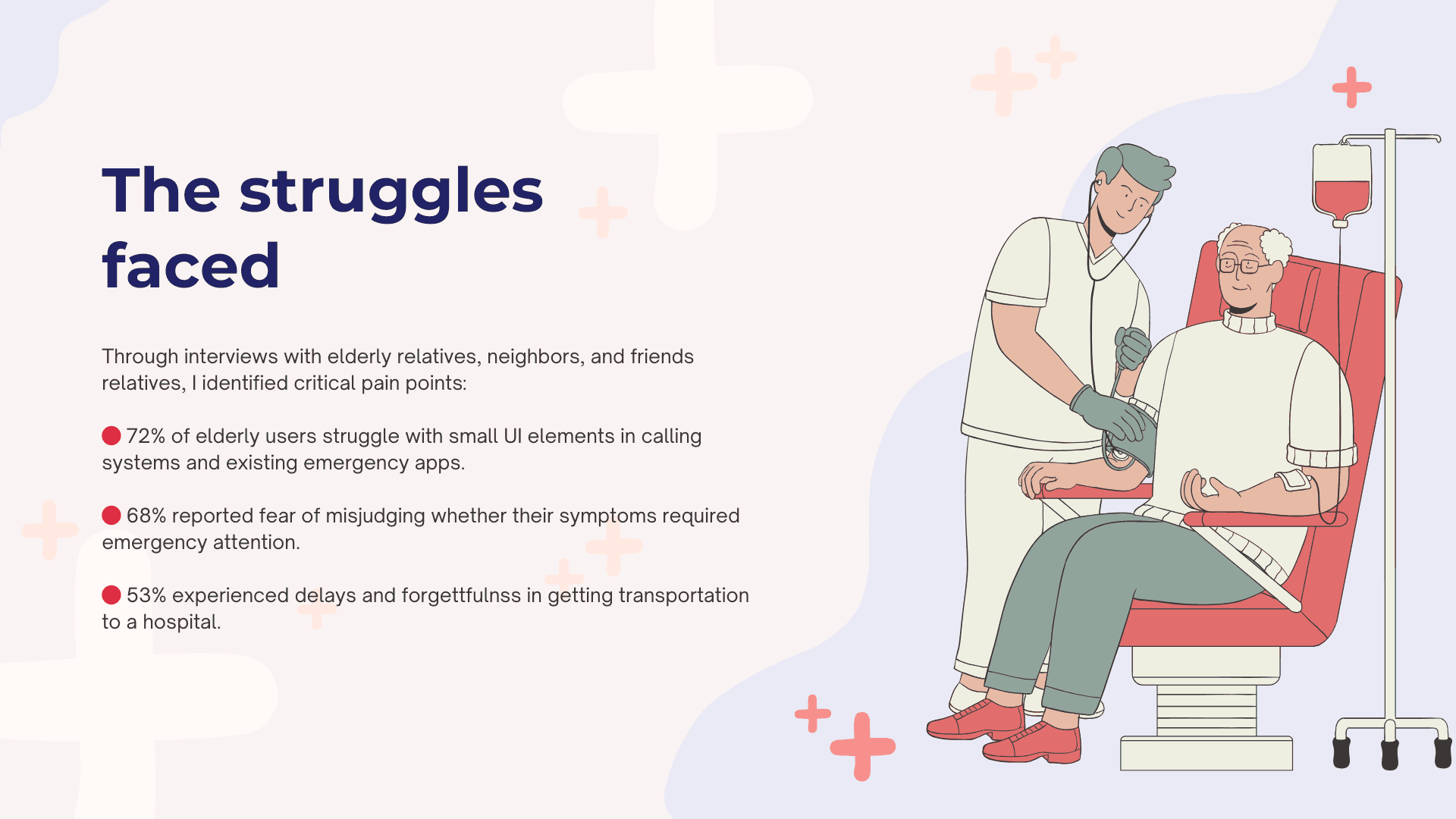
Challenges Faced
Users managing chronic illnesses or age-related conditions face a fragmented, high-stress care journey with limited support and little room for error.
Disjointed Health Management
Medical records, prescriptions, vitals, and notes are scattered across files, apps, hospitals, and memory, leaving users and caregivers overwhelmed.Low Tech Usability for the Elderly
Shaky hands, vision impairments, and lack of digital literacy make most health apps unusable for elderly users.Missed Medications, Appointments & Follow-ups
Without structured reminders, users often forget to take meds or attend checkups, leading to worsened symptoms, repeat hospital visits, or medical emergencies.Emotional Strain and Isolation
Chronic conditions are emotionally draining. Lack of support can leave patients feeling fearful, alone, and helpless in managing their health.Overburdened Informal Caregivers
Loved ones often step into the caregiver role without tools, training, or systems, juggling tasks, missing signs, and burning out.Emergency Vulnerability
In case of a fall, stroke, or heart attack, there's no immediate support unless someone happens to be nearby.Lack of Personalized, All-in-One Care Tools
Most digital health products are either too generic or hyper-specialized, ignoring the interconnected nature of long-term care.
Competitor Overview
Competitor | USP / Focus | What Works Well | Limitations / Gaps |
|---|---|---|---|
Tata 1mg / Practo | Online doctor consults, tests, e-pharmacy | Full ecosystem for diagnosis and treatment | Not built for daily chronic care or elderly accessibility |
Medisafe / MyTherapy | Medication tracking & reminders | Intuitive reminders, dosage logs | No doctor access, emergency tools, or health records |
Apple Health / Aarogya Setu | Health record aggregation | Syncs reports, tracks vitals | Not user-friendly for elderly, lacks guidance and reminders |
Life Alert / Fall apps | Emergency alerts & monitoring | Instant SOS, fall detection, location tracking | No health management, records, or medication scheduling |
Stakeholders
The app serves a range of users with distinct but interconnected needs.
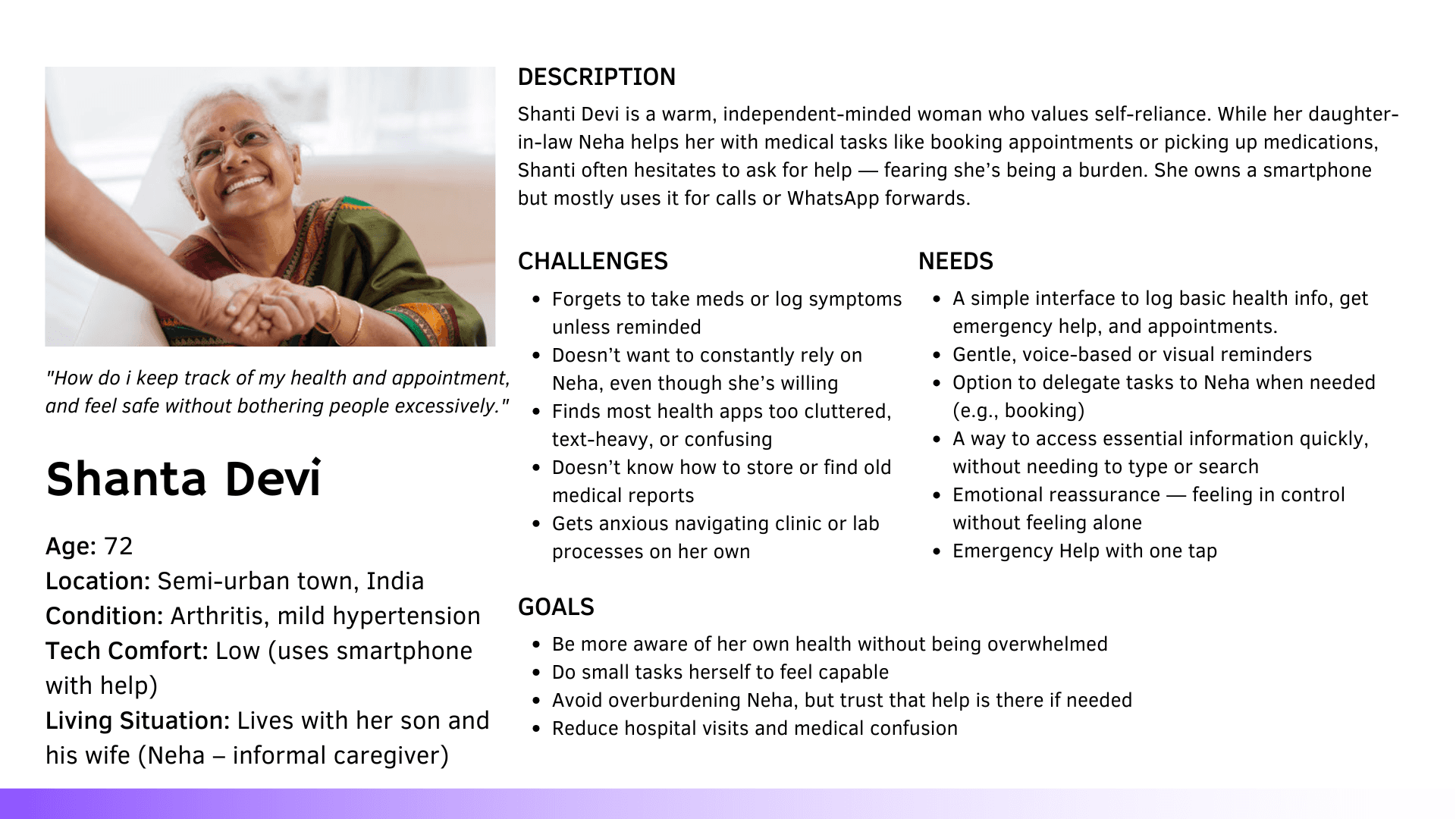
Elderly and chronically ill individuals need a reliable, easy-to-use tool to manage medications, appointments, emergencies, and vitals in one place.
Primary caregivers require timely updates and reminders to support loved ones without burnout.
Doctors and clinics benefit from better patient compliance and access to structured health data.
Emergency responders need immediate access to critical medical information during crises.
Pharmacies, though secondary, can benefit from improved prescription adherence and refill tracking.
User Personas
Primary user 1 - Patient, Elderly and chronically ill individuals
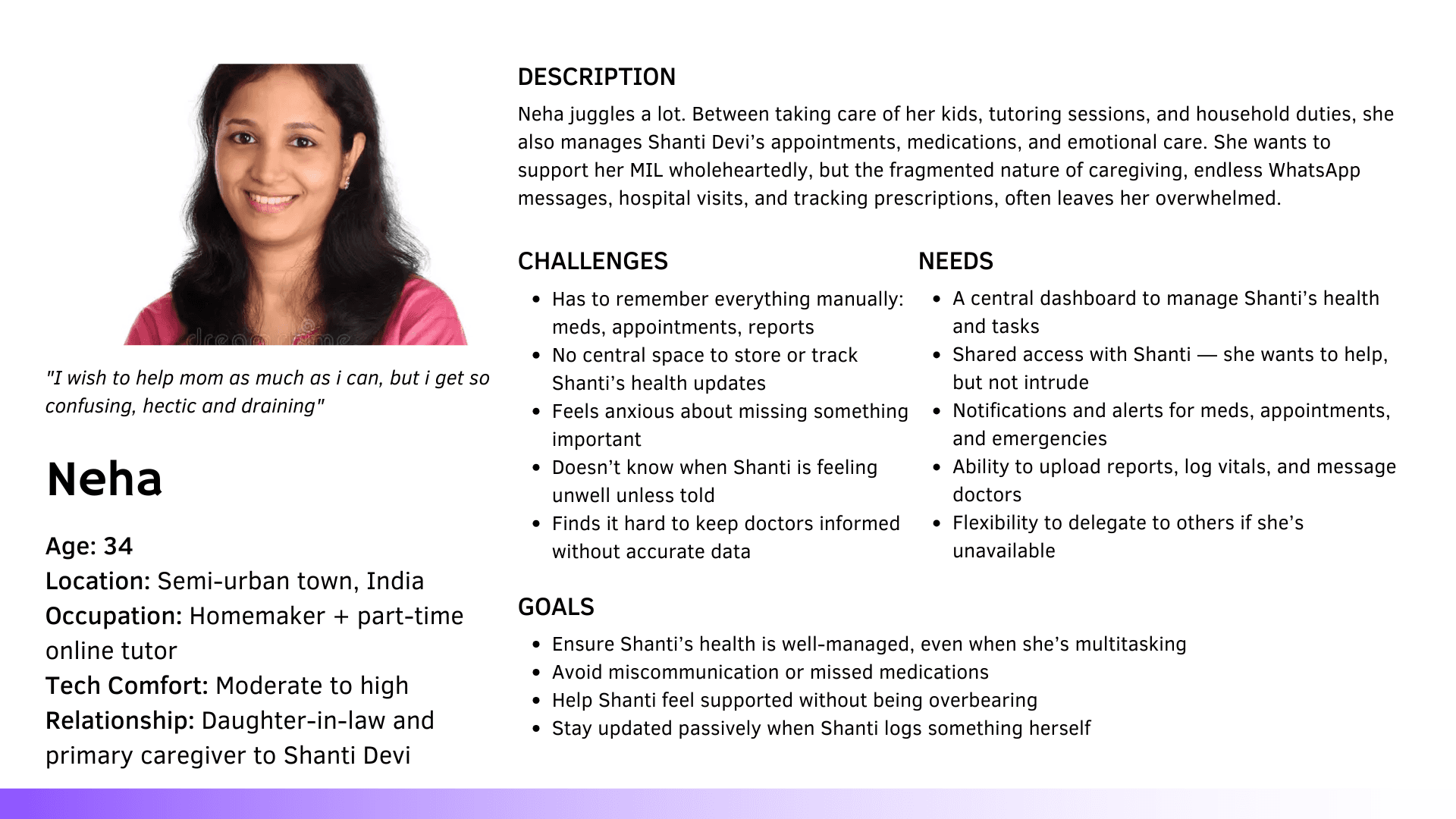
Primary user 2- Caregivers
Ideation
With a clear understanding of our users’ contexts, challenges, and needs, i moved into the ideation phase. The goal here was to generate actionable ideas that could directly address the pain points discovered during research, especially around autonomy, safety, and collaboration in caregiving.
How Might We's
I started by framing key design challenges as “How Might We” questions to explore different angles of the problem space. For each HMW, I conducted rapid brainstorming sessions and organized solutions using a FigJam board. This helped in visualizing the user goals, touchpoints, and context-based solutions.
HMW ensure quick, panic-free Management of medical emergencies?
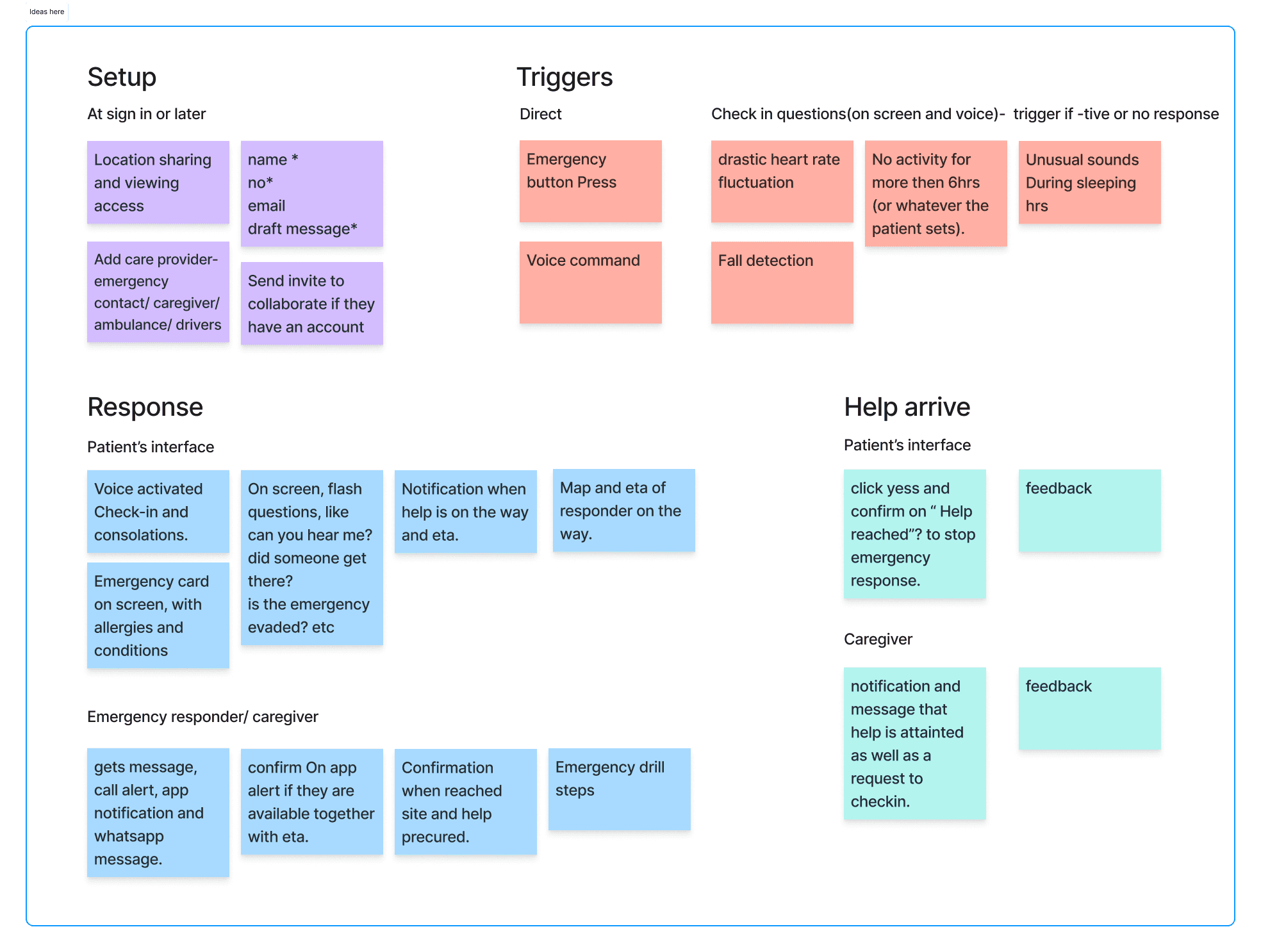
HMW establish flexible and seamless collaboration between caregivers and patient?
Care often falls apart due to miscommunication or inconsistent updates. I explored ways to build shared visibility and task coordination between primary users and their caregivers, be it family members, nurses, or doctors.HMW help patients stick to medication and care routines without stress?
Compliance can be tough when memory, energy, or motivation are low. My ideas focused on gentle, timely nudges and intuitive reminders that reduce cognitive load rather than add to it.HMW support the emotional well-being of elderly and chronically ill users?
Health is not just physical. I explored how the app could serve as a source of comfort, check-ins, and positive reinforcement, helping users feel seen, connected, and emotionally safe.HMW simplify booking appointments and arranging transport?
Navigating hospital systems and transport logistics is often a nightmare. I brainstormed features that could offer a smooth, integrated experience for scheduling appointments and ensuring timely, accessible travel.HMW help patients easily track and share their medical history and vitals?
Accessing scattered medical data is a frustrating task. I explored solutions to consolidate records and make sharing them with doctors or caregivers as easy and secure as sending a message.
Minimum Viable Product (MVP)
Feature | Description |
|---|---|
Emergency Access | Floating button triggers full-screen mode; voice-activated if idle. Shares location & key health info. |
Caregiver Hub | Manage caregivers and emergency contacts. Set access roles and quick-call/message functions. |
Home Dashboard | Overview of today’s appointments, meds, and reminders. Includes emotional check-in slider. |
Reminders | Custom alerts for meds, check-ups, or routines. Nudges for missed actions. |
Appointment Booking | Book new or record offline appointments. Transport requests optional for future versions. |
Medical Records | Store & share key documents and vitals manually. One-tap share with caregivers/doctors. |
Profile Setup | Input medical history, location access, sharing access, allergies, preferences, voice settings, and basic demographic data. |
AI Health Companion | Chatbot for FAQs, symptom triage, emotional support, and assistance with navigating app features. |
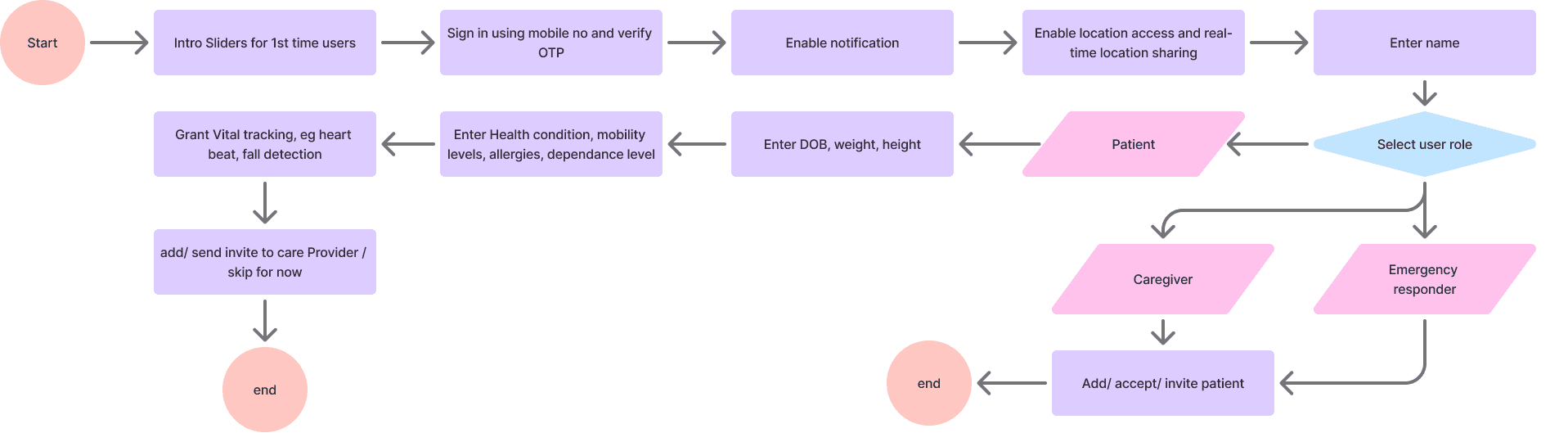
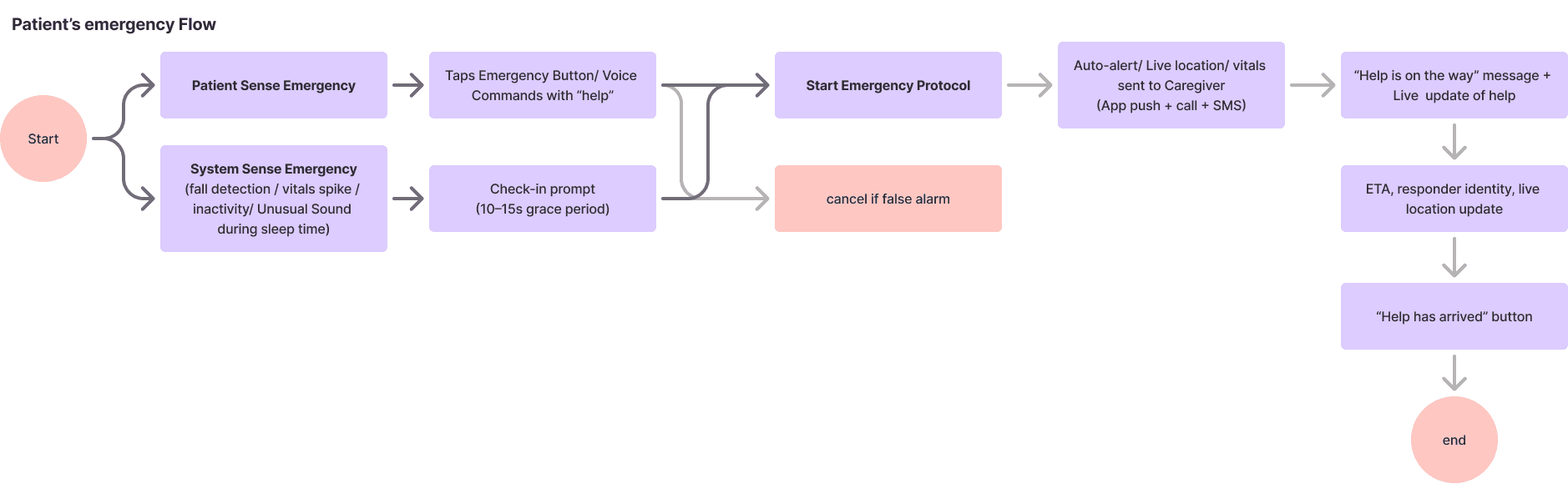
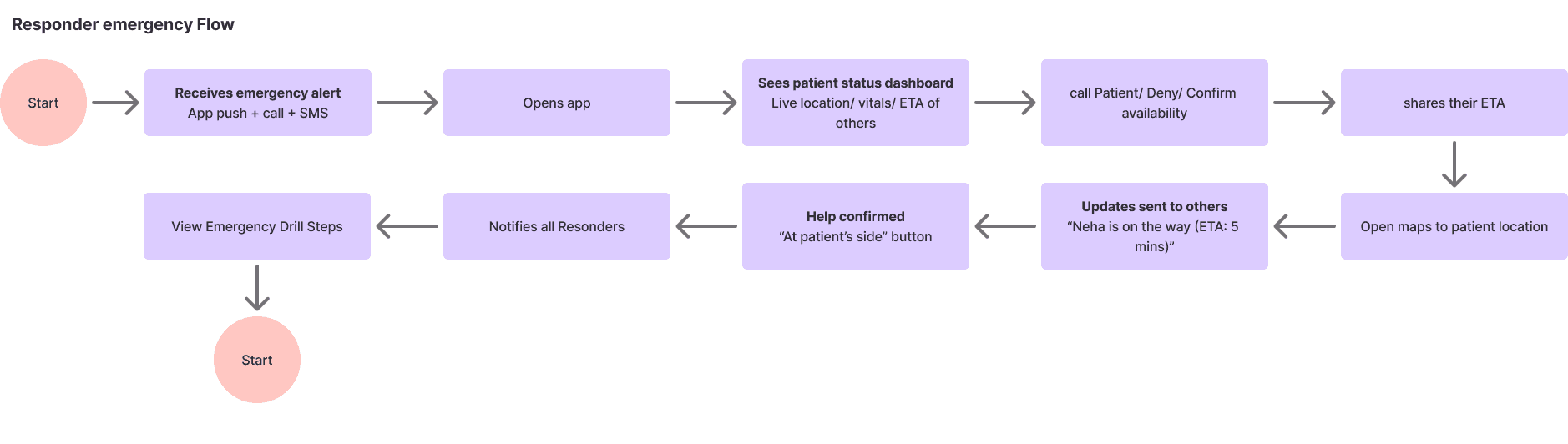
Task Flow (Onboarding and Emergency Protocol)
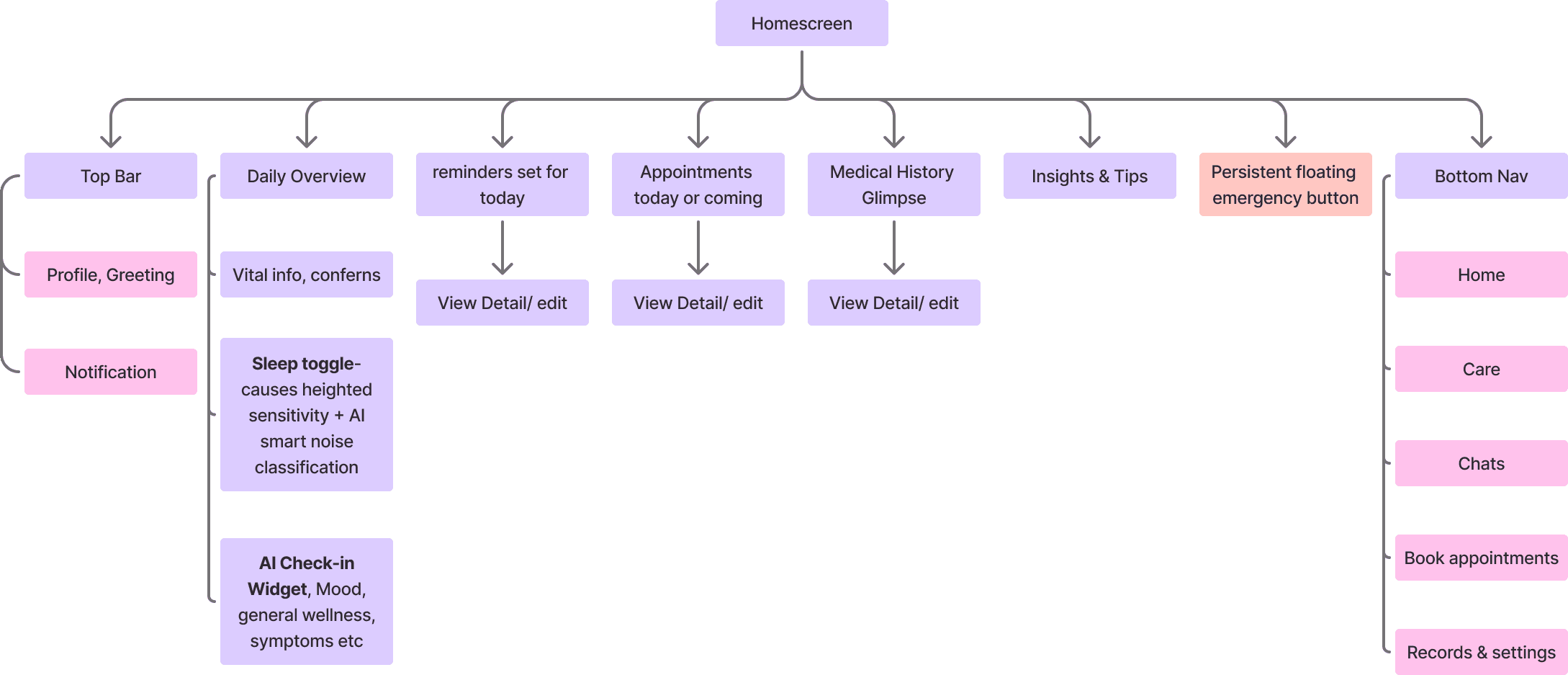
Information Architecture (Home Screen)
Design
I focused on creating a calm, clear interface that supports both patients and caregivers in moments of stress or routine. Each screen was designed to reduce overwhelm and make help, records, and reminders easy to access.
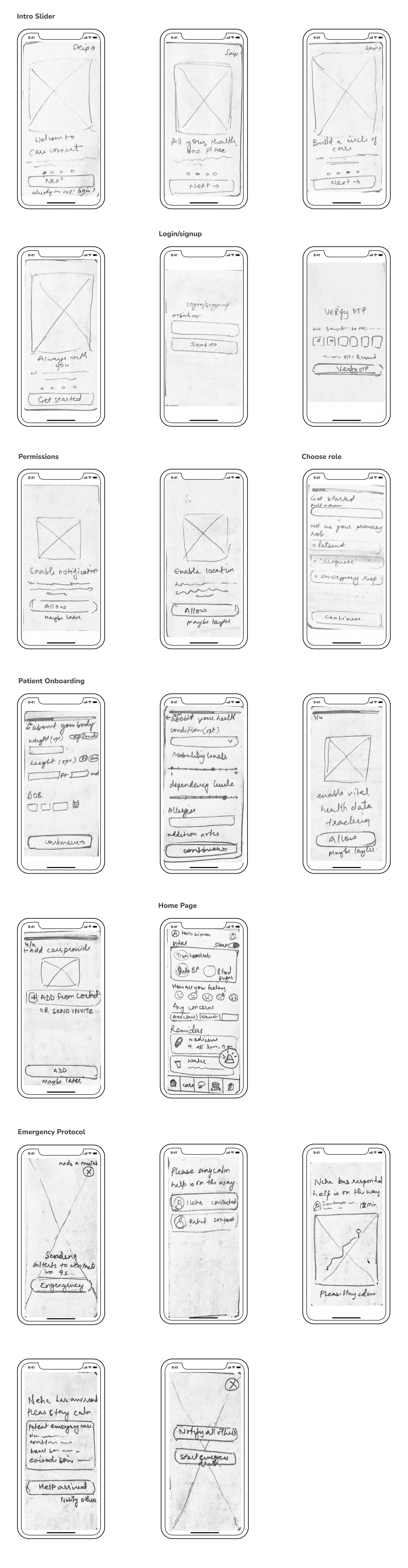
Paper Wireframes
Iteratively designed wireframes to test layout and navigation, focusing on clear visual hierarchy and intuitive interactions and to map out core user flow.
03
Conclusion
This project is still in progress.
This case study highlights my ability to design for accessibility, simplify complex problems, and deliver impact-driven solutions.
04